A powerful new model matters most when ordinary people can actually access it.
Google’s October announcement brings a frontier model into the Gemini app, where ordinary people meet it through tasks rather than benchmark tables. A feature becomes important only when it changes what the user can complete. The distinction between a new model and a genuinely better assistant matters.
Google says Gemini 4 Argon is now available in its app for eligible subscribers, alongside tighter links between reasoning, coding and task-oriented workflows.
Three things to know
- 01Google announced Gemini 4 Argon availability in the Gemini app for eligible AI Pro and Ultra subscribers.
- 02Its update highlights complex reasoning, coding support and task execution.
- 03The product story is increasingly about connected workflows, not model quality in isolation.
What does that actually mean?
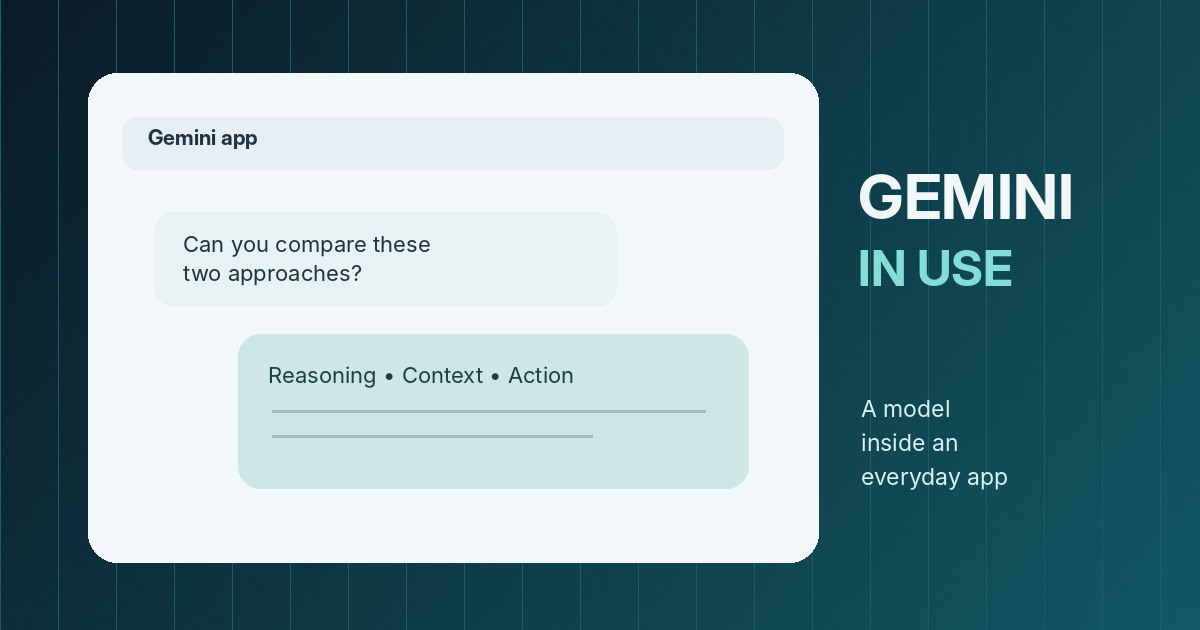
The model is the engine; the app is the dashboard through which most people experience its strengths and limitations.
From model launch to everyday access
Google introduced Gemini 4 Argon earlier in October with a staged approach to frontier access. On 13 October, the company announced Argon’s arrival in the Gemini app for Google AI Pro and Ultra subscribers.
Its announcement emphasizes reasoning for difficult tasks and coding, while pointing to an agentic coding interface in the Gemini macOS app. Google also describes a switch between ordinary chat and tasks that can continue beyond a single exchange.
Why this is worth following
The practical difference between model releases increasingly depends on how well they connect to the work people are trying to complete. Linking reasoning to code, applications and task execution can reduce the distance from an idea to an outcome.
Availability, permitted actions and connected-app support still depend on the product and account. It is important to distinguish what Google has announced from what every user can currently access.
The takeaway
Evaluate Gemini 4 Argon as a workflow product as well as a model. The most useful comparisons will test complete tasks under the same conditions, including how reliably the system handles handoffs and corrections.
What the announcement does not settle
The availability announcement confirms deployment but does not guarantee identical access for every person, country or account. Check the supported tiers and staged rollout in Google’s official release. Model capability, product packaging, and user privacy are separate questions worth examining.
The original Google announcement is linked below and is dated 2026-10-13. This article distinguishes that primary-source record from editorial interpretation. See the announcement
The availability announcement confirms deployment but does not guarantee identical access for every person, country or account.
The practical consequence
For a student, a stronger assistant may help organize research questions; for a developer, it could change which planning tasks are practical inside a chat application. The experience depends on what the app actually makes available.
Before judging a release, check whether the demonstrated capability has reached the version, language and account tier you use. A model announcement and broad public availability are not necessarily the same thing.
A question worth asking
Which real tasks improve enough for someone to notice without seeing a model name?
A useful way to assess the announcement beyond the headline.Read further
Original announcements and independent coverage, linked directly for closer reading.