The important shift is less about a model name and more about choosing when to reason more carefully.
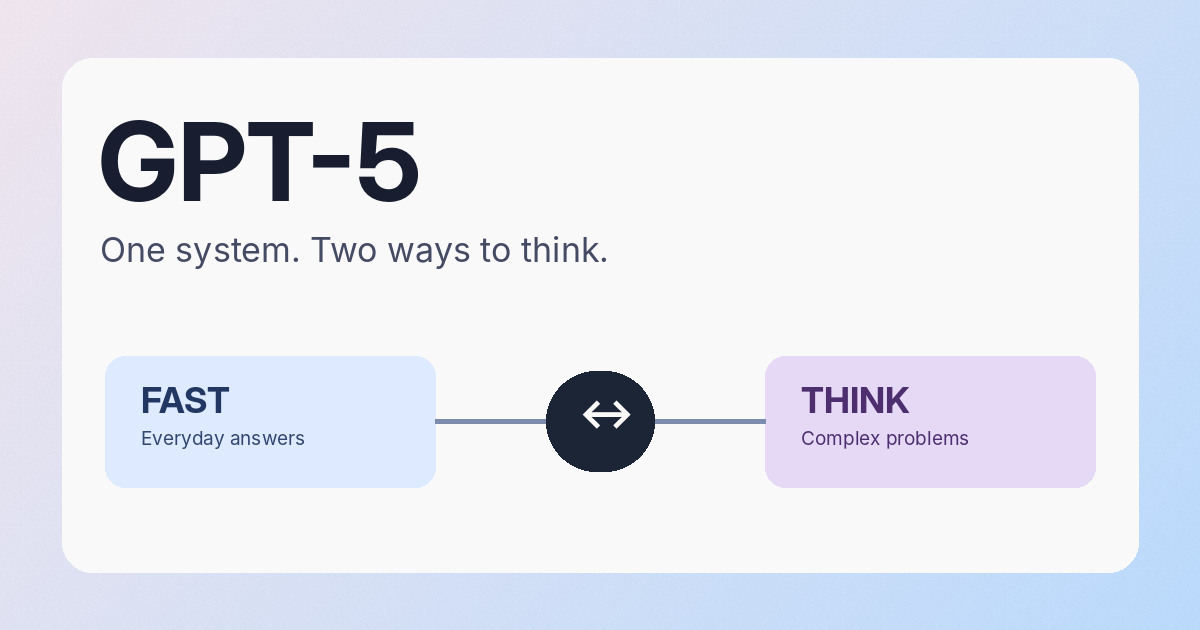
On August 7, 2025, OpenAI presented GPT-5 as a unified ChatGPT experience able to route between quick responses and more deliberate reasoning. The milestone is worth remembering because users increasingly care about the quality of the outcome, not which engine was selected.
OpenAI’s 2025 release helped normalize the idea of one assistant choosing when to think longer. The story below separates the announcement from its broader implications and limitations.
Three things to know
- 01GPT-5 was announced in August 2025 as a unified system.
- 02OpenAI described a combination of faster responses, deeper reasoning and routing between them.
- 03It marked an important shift in consumer expectations for everyday AI.
The original OpenAI announcement is linked below and is dated 2025-08-07. This article distinguishes that primary-source record from editorial interpretation. See the announcement
Initial launch evaluations are not permanent guarantees.
What does that actually mean?
You do not calculate every grocery total with a research-grade computer, but a difficult proof might deserve extra attention.
What actually happened
GPT-5 was announced in August 2025 as a unified system. OpenAI described a combination of faster responses, deeper reasoning and routing between them.
OpenAI described GPT-5 as a system combining a fast model, more deliberate reasoning and routing. The approach brought different modes of reasoning into one commonly used product.
Why this matters
Instead of asking a user to choose a separate reasoning model for every question, a unified system can vary how much work it puts into the response. That makes sophisticated models easier to approach.
Longer reasoning is not an objective in itself. The practical challenge is to spend additional compute only where it improves the answer and to admit uncertainty when it does not.
What to be careful about
A model launch reflects performance at its announcement date. The latest systems and prices will have changed since then, so historical comparisons need clear dates.
What to watch next
The durable question is whether automatic routing delivers the right depth of reasoning without wasting time or producing an unjustified appearance of certainty.
Compare the launch with newer products using the same questions and evaluation criteria. Model names alone cannot tell a user what improved.
The practical consequence
People do not always know in advance whether a question requires a quick answer or careful reasoning. A single assistant that changes its approach could make this distinction less burdensome.
Even when deeper reasoning is available, verification remains essential for high-stakes topics. Confidence, source quality and the ability to acknowledge uncertainty are separate from thinking time.
A question worth asking
How can a product communicate when it is switching to slower, more deliberate reasoning?
A useful way to assess the announcement beyond the headline.Read further
Original announcements and independent coverage, linked directly for closer reading.